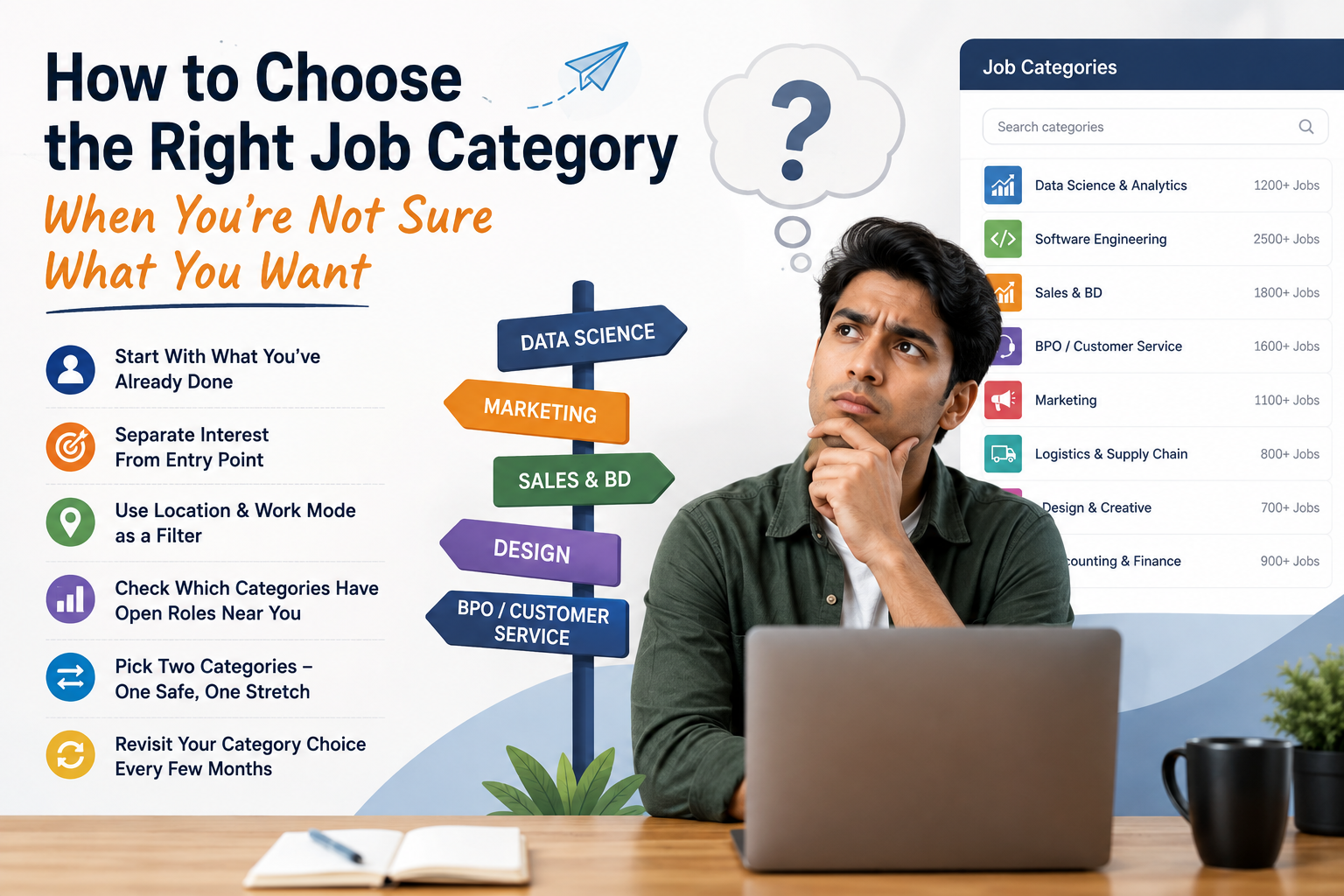
How to Choose the Right Job Category When You're Not Sure What You Want
Scrolling through a job portal with 100+ categories — Data
Science, BPO, Interior Design, Logistics, Sales — can feel overwhelming instead
of helpful. If you've ever opened a category list and closed it five minutes
later without applying anywhere, you're not alone. Most job seekers don't
struggle because there aren't enough options; they struggle because there are
too many.
Here's a practical way to narrow it down.
Start With What You've Already Done, Not What Sounds
Exciting
It's tempting to chase a category because it looks glamorous
— Graphic Design, Digital Marketing, Data Analytics. But the fastest path to an
offer is usually the category closest to your actual experience. If you've
handled customer calls, BPO / Customer Service roles will take you seriously on
day one. If you've managed billing or vendor payments, Accounting / Auditing
categories will see you as job-ready, not a risk. Save the pivot for after you
have income and stability.
Separate "Interest" From "Entry
Point"
You can be interested in UX Design long-term while entering
the workforce through QA or Customer Support. Many categories — IT &
Information Security, Software Engineering, Product Management — are easier to
move into from an adjacent role than to break into cold. Ask: is this
category my entry point, or my destination? Both are valid, but knowing which
one you're picking changes how you apply and what you say in interviews.
Use Location and Work Mode as a Filter, Not an
Afterthought
Categories like Delivery / Driver / Logistics, Facility
Management, and Security Services are almost always location-bound and on-site.
Categories like Content & Editorial, Data Science & Analytics, and
Software Product roles are far more likely to offer work-from-home options. If
flexibility matters more to you than title, filter by work mode first, then
browse categories within that filter — not the other way around.
Check Which Categories Actually Have Open Roles Near You
A category with zero active jobs in your city is a dead end,
no matter how well it matches your skills. Before you build your resume around
a category, check the live listings for it in your location. If Bengaluru has
strong demand in Sales & BD and BPO but almost nothing in Architecture,
that tells you where your effort will convert fastest, at least for now.
Don't Pick One Category — Pick Two
One "safe" category close to your real experience,
and one "stretch" category you're building toward. Apply actively in
the safe one while you use the stretch category to test the market, refine your
resume, and see what employers in that space actually ask for. This keeps
income moving while you grow.
Watch for Categories That Overlap More Than They Look
Like They Do
Job portals list categories as if they're separate boxes,
but a lot of real-world roles sit across two or three of them at once. A
"Digital Marketing Executive" role might also touch Social Media
Marketing, Content & Editorial, and Data Science & Analytics in the
same job description. Instead of hunting for the one perfect category, search
using two or three related terms and compare descriptions. You'll often find
your actual skill set fits more categories than you first assumed, which opens
up far more live listings.
Let Salary Bands Tell You Something, Too
Categories aren't just about the type of work — they also
carry very different typical salary ranges. Sales & BD and Telecalling
roles often start lower but scale fast with incentives and targets. IT &
Information Security, Data Science & Analytics, and Software Engineering
usually start higher but expect more specific technical proof (certifications,
past projects, test scores). Before committing your job search to one category,
check a handful of live listings for the actual ₹ range being offered near you
— not what you assume the industry pays. It changes by city, and sometimes by
month.
Revisit Your Category Choice Every Few Months
The category that made sense when you started applying might
not make sense six months later — you'll have more experience, a clearer sense
of what interviews are actually asking for, and possibly a different city or
work-mode need. Treat your category selection as a decision you check in on,
not one you make once and forget. Re-browsing categories periodically also
surfaces newer, less crowded categories where competition is lower and response
rates are higher.
A Simple Weekly Habit That Speeds This Up
Instead of browsing categories once and hoping, spend 15
minutes a week doing this:
- Filter
jobs by your "safe" category and location — apply to anything
genuinely relevant.
- Filter
by your "stretch" category — read 5 descriptions closely, even
if you don't apply yet.
- Note
any skill, tool, or certification that keeps showing up across postings
you don't currently have.
- Spend
the rest of the week closing that one gap, rather than spreading effort
thin across everything.
Over a few weeks, this turns a vague "I don't know what
I want" into a specific, evidence-based direction — driven by what
employers are actually hiring for, not by guesswork.