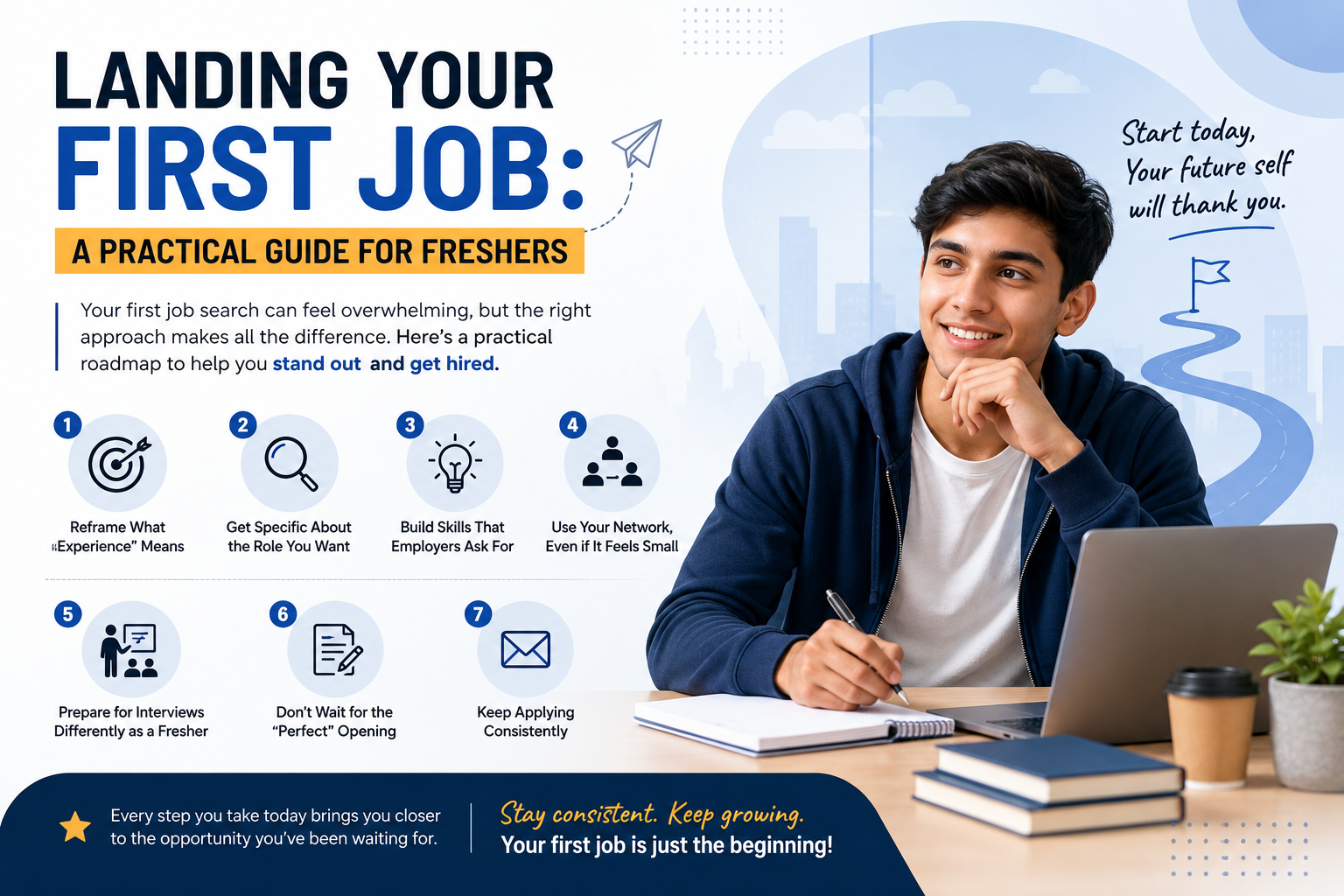
Landing Your First Job: A Practical Guide for Freshers
Your first job search feels different from every one after
it. There's no work history to lean on, no reference from a previous manager,
and every application form asks for "years of experience" you simply
don't have yet. It's easy to feel stuck before you've even started. The good
news is that freshers get hired every single day — you just need a strategy
built for where you actually are, not for someone five years into their career.
Here's a practical way to approach it.
1. Reframe What "Experience" Means
You may not have a job title yet, but you likely have more
relevant experience than you think — college projects, internships, freelance
work, volunteering, part-time gigs, or even personal projects. A final-year
project where you built a small app, ran a college event, or managed a social
media page for a club all count. Employers hiring freshers aren't expecting a
résumé full of job titles; they're looking for signs that you can learn fast,
take initiative, and follow through.
List these experiences the same way you'd list a job: what
you did, what tools or skills you used, and what the outcome was.
2. Get Specific About the Kind of Role You Want
"I'll take anything" feels like the safest
strategy when you're starting out, but it usually backfires. Applying broadly
across unrelated roles — sales one day, IT support the next — makes it hard to
build a focused resume or a convincing cover letter for any one of them.
Instead, narrow down to two or three role types that
genuinely interest you, based on your degree, coursework, or projects. A
focused search lets you tailor your applications properly and lets recruiters
immediately see the fit.
3. Build Skills That Employers Are Actually Asking For
Many entry-level job descriptions list specific tools or
skills — Excel, basic SQL, Canva, CRM software, spoken English proficiency, and
so on. If you're missing a few of these, it's worth spending a few weeks
closing the gap before you apply, rather than hoping it won't come up in the
interview. Free and low-cost resources — YouTube tutorials, short certification
courses, and practice projects — can get you conversational in most entry-level
tools within a few weeks.
4. Use Your Network, Even if It Feels Small
You don't need years of professional contacts to make
networking work for you. Seniors from your college, professors, family friends
in your target industry, and alumni groups are all valid starting points. A
short, polite message asking for advice — not a job — often opens more doors
than a cold application ever will. Most people are happy to share what helped
them get their own first role.
5. Prepare for Interviews Differently as a Fresher
Interviewers hiring freshers usually aren't testing deep
expertise — they're testing attitude, communication, and potential. Be ready to
talk through:
- A
project or situation where you solved a problem, even a small one
- Why
you're interested in this specific role or industry
- What
you did during college beyond academics
- How
you handle feedback or unfamiliar tasks
Practice answering out loud, not just in your head. It's a
different skill, and it shows in how confident you sound in the actual
interview.
6. Don't Wait for the "Perfect" Opening
Many freshers hold off applying because a listing asks for
"1-2 years experience" or feels slightly out of reach. In practice,
many of these requirements are flexible, especially for entry-level postings,
and companies often adjust based on a strong candidate. If you meet most of the
requirements and the role genuinely interests you, apply anyway.
7. Keep Applying Consistently
A single rejection — or even ten — doesn't reflect your
overall potential. Hiring for entry-level roles depends on timing, team needs,
and sheer volume of applicants as much as anything else. Treat your job search
like a habit: set aside time each week to apply, follow up, and refine your
resume based on what you're learning from each round.