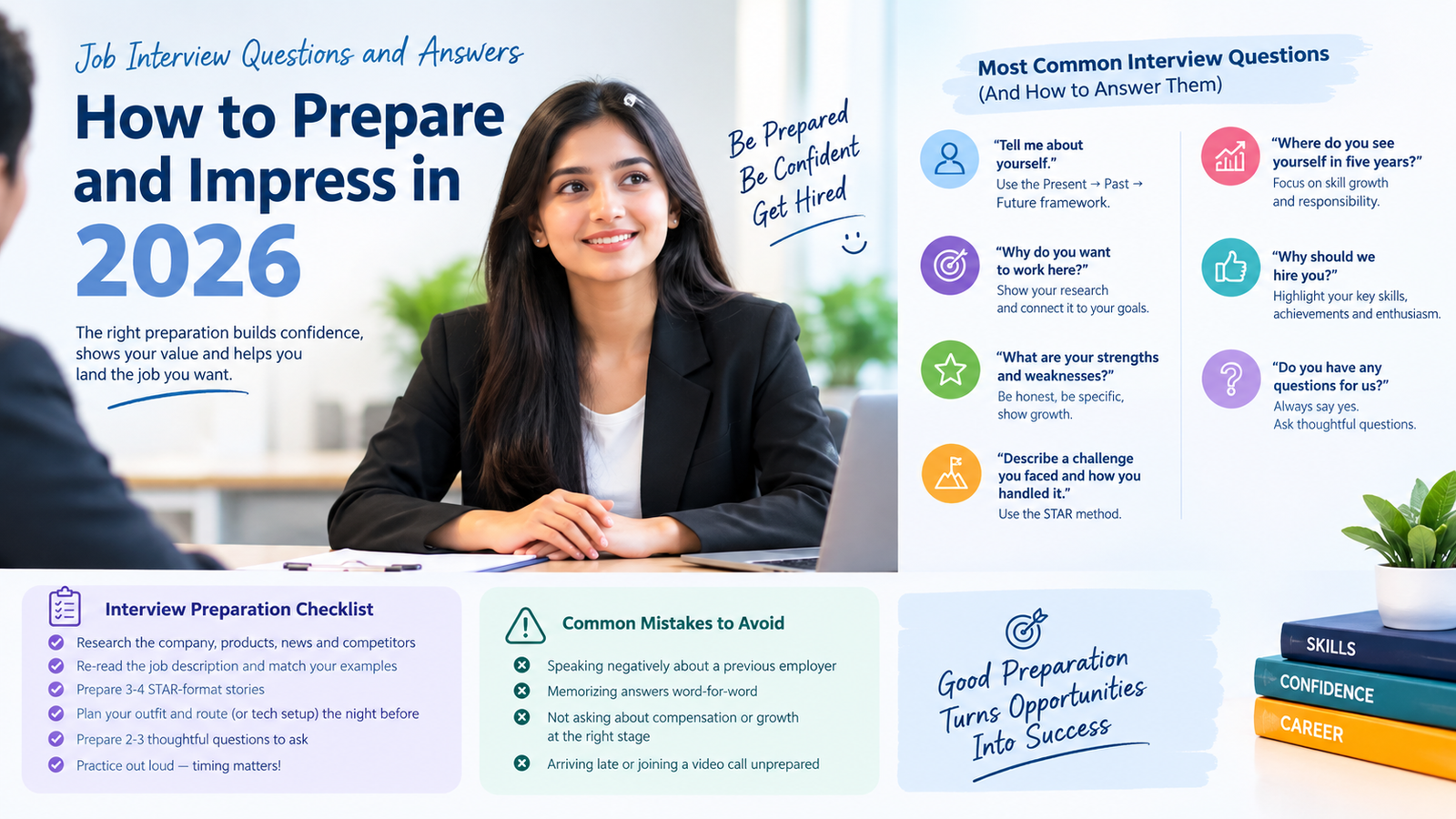
Job Interview Questions and Answers: How to Prepare and Impress in 2026
Landing the interview is only half the battle. What you say
in the next 30-45 minutes decides whether you get the offer letter or the
polite rejection email. Every year, hiring patterns shift a little, but one
thing stays constant: candidates who prepare with structure always outperform
candidates who "wing it."
This guide breaks down the most common interview questions
recruiters ask in 2026, along with answer frameworks you can adapt to your own
experience — whether you're a fresher applying for your first job or a
professional targeting a senior role.
Why Interview Preparation Matters More Than Ever
Hiring in 2026 is faster and more competitive. Recruiters
often screen dozens of candidates for a single opening, and many companies now
use a mix of HR rounds, technical rounds, and panel interviews even for
mid-level roles. A well-prepared candidate signals reliability before a single
technical question is even asked.
If you're actively browsing openings, platforms like
Jobhunterr list verified roles across IT, sales, finance, HR, and more — so you
can match your preparation to the specific job description rather than
preparing generically.
The Most Common Interview Questions (And How to Answer
Them)
1. "Tell me about yourself."
This is not an invitation to repeat your resume line by
line. Recruiters want a 60-90 second summary that connects your background to
the role.
Framework: Present → Past → Future
- Present:
your current role or academic status
- Past:
one or two achievements relevant to the job
- Future:
why this specific role is your next logical step
2. "Why do you want to work here?"
This question tests whether you researched the company.
Avoid generic answers like "it's a great opportunity." Instead,
mention something specific — a product, a market they operate in, or a value
they publicly emphasize — and connect it to your own goals.
3. "What are your strengths and weaknesses?"
For strengths, pick one that's directly relevant to the job
and back it with a quick example. For weaknesses, choose something real but not
disqualifying, and show what you're doing to improve it. Never say "I'm a
perfectionist" — interviewers have heard it too many times to find it
convincing.
4. "Describe a challenge you faced and how you
handled it."
Use the STAR method:
- Situation
— set the context briefly
- Task
— what you were responsible for
- Action
— what you specifically did
- Result
— the measurable outcome
This structure keeps your answer focused and shows
problem-solving ability instead of just narrating events.
5. "Where do you see yourself in five years?"
Employers ask this to gauge whether you're likely to stay
and grow with the company. Focus on skill growth and increasing responsibility
rather than naming a specific job title, unless the role has a very clear
career ladder.
6. "Why should we hire you?"
Summarize the two or three things that make you the
strongest fit — a skill, a relevant achievement, and your enthusiasm for the
specific role. Keep it under a minute.
7. "Do you have any questions for us?"
Always say yes. Good questions to ask:
- "What
does success look like in this role after six months?"
- "What's
the team structure I'd be working with?"
- "What
are the next steps in the hiring process?"
Asking no questions signals low interest, even if you were
engaged throughout the interview.
Interview Preparation Checklist
- Research
the company's products, recent news, and competitors
- Re-read
the job description and match your examples to its requirements
- Prepare
3-4 STAR-format stories you can adapt to different questions
- Plan
your outfit and route (or tech setup, for virtual interviews) the night
before
- Prepare
2-3 thoughtful questions to ask the interviewer
- Practice
out loud, not just in your head — timing matters
Common Mistakes to Avoid
- Speaking
negatively about a previous employer — it raises red flags about
professionalism
- Memorizing
answers word-for-word — it sounds robotic; know your key points
instead
- Not
asking about compensation or growth at the right stage — save detailed
negotiation for later rounds
- Arriving
late or joining a video call unprepared — punctuality is often an
unspoken evaluation criterion