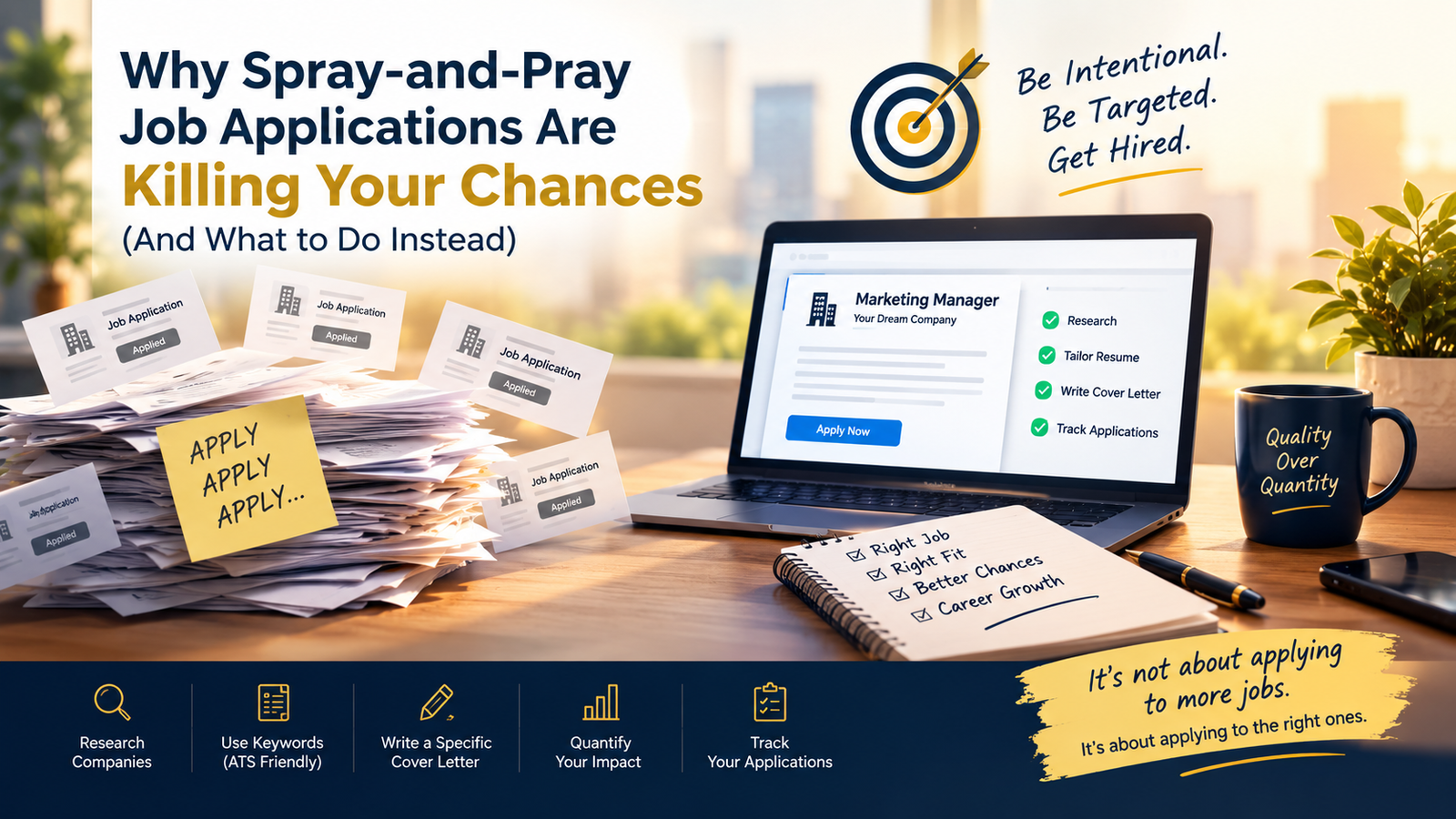
Why Spray-and-Pray Job Applications Are Killing Your Chances (And What to Do Instead)
Job searching today can feel like a numbers game. Scroll,
click apply, repeat — sometimes fifty or a hundred times a week. It's tempting
to believe that more applications equal more interviews. But data from
recruiters and hiring platforms tells a different story: candidates who apply
broadly and generically often see lower response rates than those who apply to
fewer, better-matched roles. The job search isn't a lottery — it's a targeting
problem.
Why "apply to everything" backfires
- ATS
systems filter you out before a human sees your resume. Most mid-size
and large companies use Applicant Tracking Systems that scan resumes for
keyword matches tied to the job description. A generic resume that doesn't
mirror the language of the posting can get auto-rejected, regardless of
how qualified you actually are.
- Recruiters
can spot a template from a mile away. A cover letter that says "I
am excited to apply for this position at [Company]" with no specific
detail about the company, team, or role signals low effort — and
recruiters read dozens of these a day.
- You
dilute your time and energy. Every hour spent applying to a role
you're only 40% qualified for is an hour not spent tailoring an
application for a role you're genuinely a strong fit for.
- It
hurts your morale. Sending out dozens of applications and hearing
nothing back is demoralizing — and that fatigue often shows up in
interviews for the roles that matter.
The smarter approach: targeted, tailored applications
1. Research before you apply
Spend 10–15 minutes understanding the company's mission, recent news, and the
specific team you'd be joining. This context helps you write a cover letter
that actually says something, and it prepares you for interview questions like
"why do you want to work here?"
2. Mirror the job description's language
If the posting says "cross-functional collaboration" and your resume
says "worked with other departments," rewrite it. ATS systems and
human reviewers both respond to matched terminology — not because you're gaming
the system, but because it proves you understand what they're looking for.
3. Lead your cover letter with specificity
Skip the generic opening. Instead of "I am writing to apply for the
Marketing Manager position," try something like: "Your recent launch
of [product/campaign] caught my attention because it tackled [specific
challenge] — a problem I worked on directly at [previous company]."
4. Quantify your impact
"Managed social media" says little. "Grew Instagram engagement
by 34% over six months through a redesigned content calendar" says a lot.
Numbers make your resume scannable and credible.
5. Track everything
Keep a running log of where you applied, when, the contact person (if any), and
follow-up dates. Losing track of applications leads to missed follow-ups and
awkward moments when a recruiter calls about a role you don't remember applying
to.
How the right tools help
Manually tailoring every resume and cover letter is
time-consuming — which is exactly why spray-and-pray happens in the first
place. Job search platforms that combine role discovery with AI-assisted resume
tailoring, cover letter drafting, and application tracking let you apply with
precision at a sustainable pace. Instead of choosing between speed and quality,
the right tooling lets you have both: fast turnaround on each application,
without sacrificing the specificity that gets you noticed.
A quick self-check before you hit submit
Ask yourself:
- Does
my resume mention at least 3 keywords directly from this job posting?
- Does
my cover letter reference something specific to this company or role?
- Am I
actually qualified for at least 70% of the listed requirements?
- Have
I logged this application somewhere I'll remember to check?
If you answered "no" to any of these, it's worth
another 5 minutes before you apply.
Conclusion
The goal was never to apply to the most jobs — it's to apply
to the right jobs, in a way that shows you understand what the employer
needs. A focused, well-researched application strategy consistently outperforms
volume, both in response rate and in the quality of roles you land.