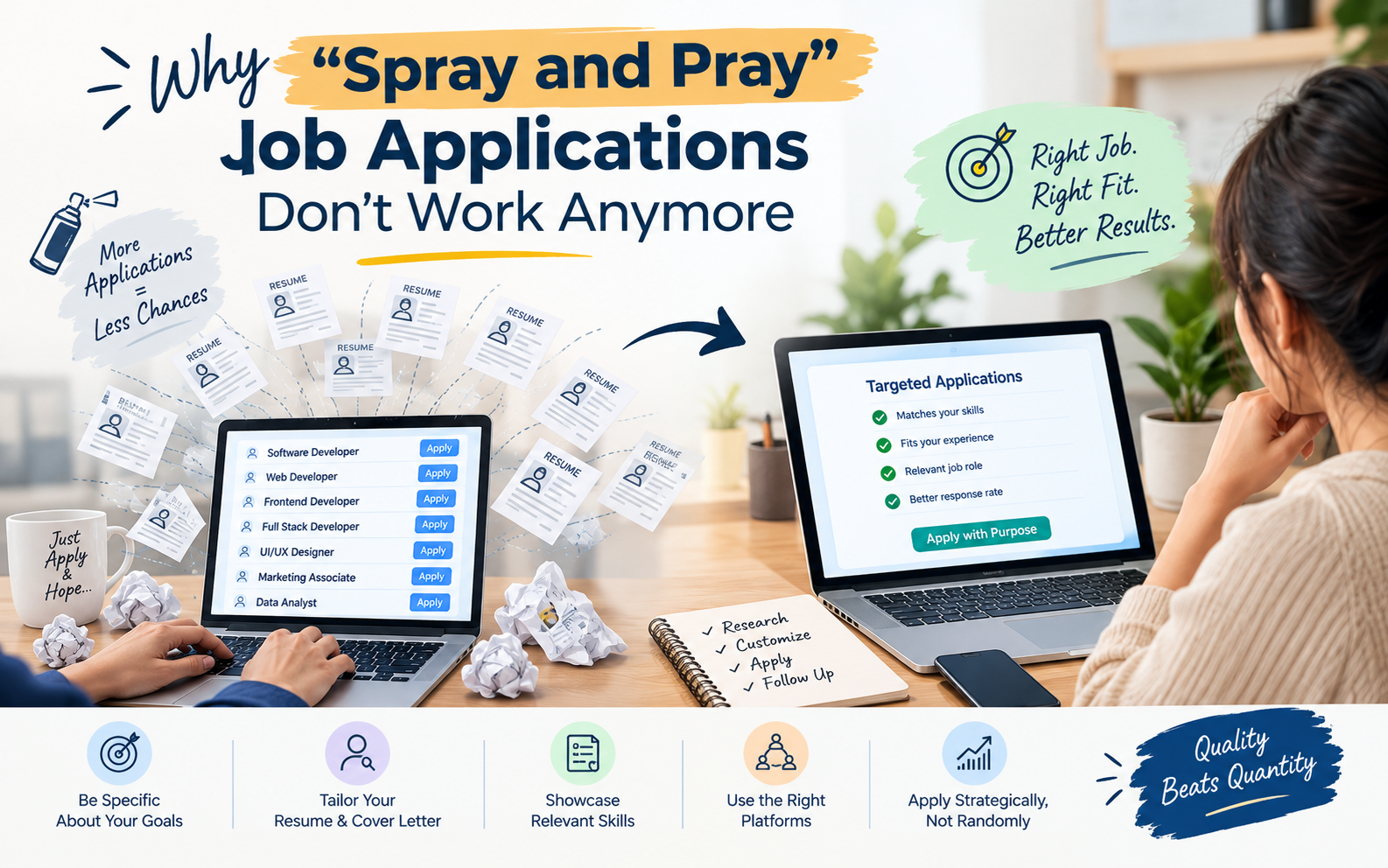
Why "Spray and Pray" Job Applications Don't Work Anymore
If you've applied to 200 jobs and heard back from three,
you're not alone — and you're not doing anything wrong by industry standards.
The problem is the standard itself.
The old playbook is broken
For years, job seekers were told that volume wins: apply to
everything, cast a wide net, increase your odds. But recruiters have adapted.
Most mid-to-large companies now run every application through an Applicant
Tracking System (ATS) before a human ever sees it. When candidates mass-apply
with generic resumes, ATS software filters out anything that doesn't closely
match the job description's language — regardless of how qualified the person
actually is.
The result: a job seeker sends out 200 applications, but a
large share of them never reach a recruiter's inbox in any meaningful way. It's
not that the market is impossible. It's that the strategy is mismatched to how
hiring actually works now.
Why volume-first hunting quietly backfires
There are a few hidden costs to the spray-and-pray approach
that job seekers rarely account for:
- Decision
fatigue. Customizing nothing feels efficient in the moment, but it
means every application is a coin flip. Over weeks, that unpredictability
is exhausting in a different way than targeted effort is — you can't tell
if you're making progress or just generating noise.
- Recruiter
pattern recognition. Hiring managers can often spot a generic,
mass-sent application at a glance — a summary that doesn't mention the
company, a cover letter that could apply to any role, skills listed with
no context. It doesn't just fail to help; it can actively signal low
effort.
- Wasted
follow-up potential. If you don't remember what you applied for or
why, you can't follow up intelligently. A generic "just checking
in" email is far less effective than one referencing a specific
detail from the job posting or your application.
- No
feedback loop. Without tracking outcomes, you can't tell which types
of roles, resumes, or channels are actually working — so you can't improve
your approach over time.
What actually moves the needle
- Relevance
over volume. A smaller number of applications tailored to roles that
genuinely fit your background will consistently outperform a much larger
batch of generic ones. Tailoring means matching keywords, reordering
bullet points to lead with relevant experience, and adjusting your summary
for each role's specific language — not rewriting your resume from scratch
every time.
- Speed
matters, but so does targeting. Being among the first wave of
applicants meaningfully increases your odds of a response, since many
recruiters start reviewing before a posting closes. This is where
automation earns its keep — not by blasting resumes everywhere, but by
helping you apply quickly to roles that are actually a fit, while the
posting is still fresh and before the applicant pool balloons.
- Tracking
beats memory. Job seekers who keep a simple system — what you applied
to, when, with which resume version, and what the follow-up plan is —
consistently convert more interviews than those relying on memory and a
cluttered inbox. A simple kanban-style board (Wishlist → Applied →
Interviewing → Offer) is often enough.
- Follow-up
is underused. A short, polite note to a hiring manager or recruiter a
week after applying is one of the least-used, highest-leverage moves in
job hunting. Most candidates never do it, which means the few who do stand
out simply by showing up.
- Networking
still outperforms cold applications. A referral or a warm introduction
— even a brief one — routinely moves a candidate further than a cold
application, because it skips the initial filtering stage entirely. Spend
a portion of your search time on outreach, not just applications.
- Know
when to walk away from a role. Not every posting deserves an
application. If a job requires five years in a tool you've never touched
and the rest of the requirements are a stretch too, that effort is often
better spent elsewhere. Being selective is a strategy, not a weakness.
A simple weekly structure that works
Rather than applying reactively whenever you see a posting,
consider structuring your search like a part-time job:
- Monday:
Search and shortlist 10–15 roles that genuinely match your background.
- Tuesday–Wednesday:
Tailor resumes and cover letters for your top 5–8 picks; submit them.
- Thursday:
Send 3–5 outreach messages to people at target companies (alumni, former
colleagues, recruiters).
- Friday:
Follow up on applications from the previous week; update your tracker.
This rhythm keeps the search sustainable instead of chaotic,
and it naturally builds in the tailoring and follow-up steps that get skipped
when applications are sent in a rush.
The shift in mindset
Think of your job search less like a lottery and more like a
sales pipeline. Sales teams don't cold-call everyone in the phone book — they
qualify leads, personalize outreach, and track every touchpoint through a CRM.
Applying that same discipline to job hunting is what separates a six-week
search from a six-month one.
Tools that combine semantic job matching, tailored resume
generation, and application tracking exist precisely to make this disciplined
approach sustainable — because doing it manually, application by application,
is exhausting even when you know it's the right strategy. Automation, used
well, doesn't replace the strategy above — it just removes the tedious parts so
you can actually stick to it.