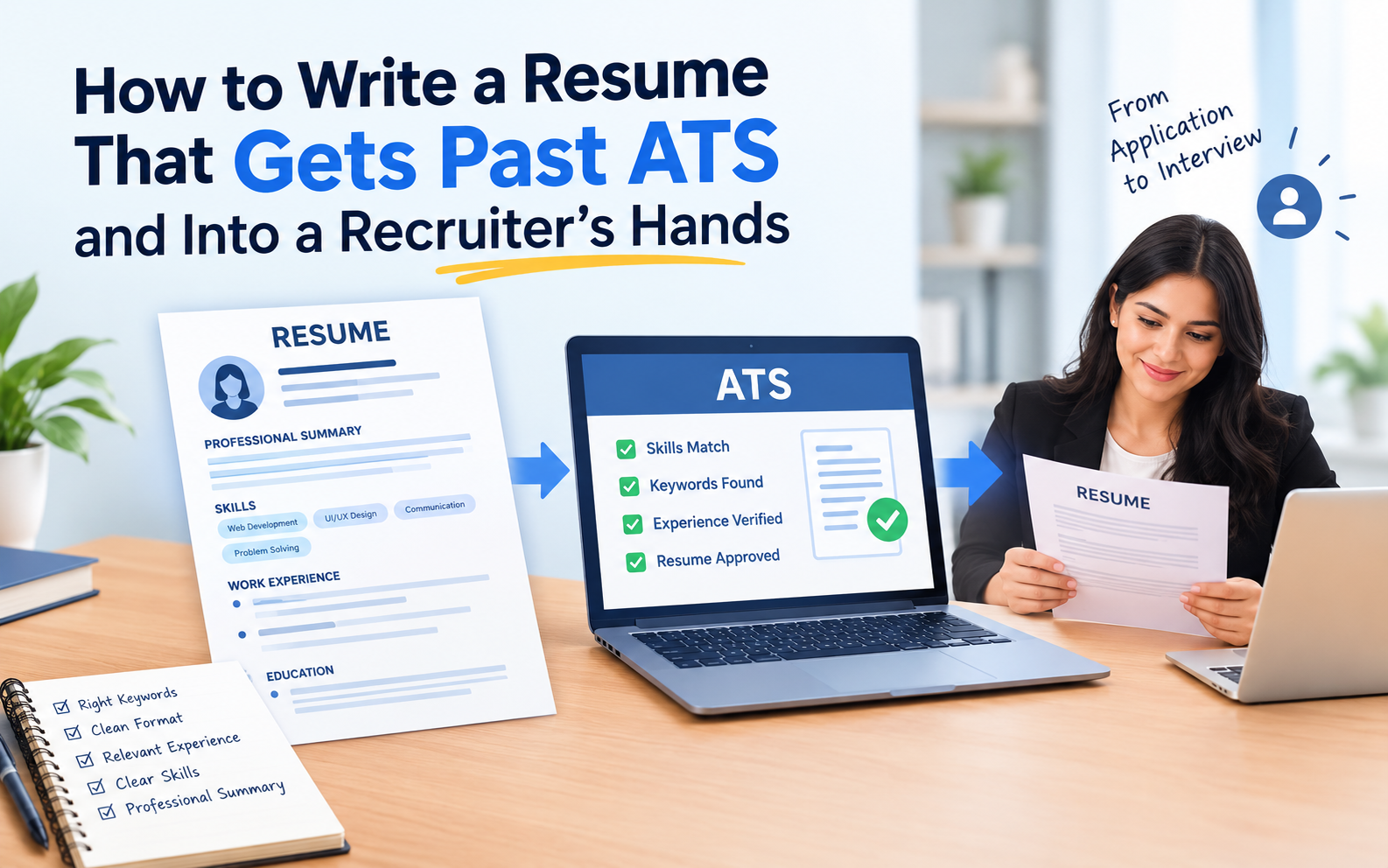
How to Write a Resume That Gets Past ATS and Into a Recruiter's Hands
You've spent hours polishing your resume, hit
"Submit," and heard nothing. It's frustrating, and the cause is often
not your experience. Your resume may never have reached a human. Before a
recruiter reads it, an Applicant Tracking System (ATS) has often already
decided whether it moves forward.
What Is an ATS and Why Does It Matter?
An ATS is software that companies use to collect, scan, and
rank job applications. When a role attracts hundreds of applicants, recruiters
use the ATS to surface the best matches. It reads your resume, pulls out
details like job titles, skills, dates, and education, and scores them against
the job description.
A strong candidate with a poorly formatted or mismatched
resume can be ranked below a weaker one whose resume is simply easier for the
system to read. Understanding how it works gives you a real advantage.
Step 1: Study the Job Description Before You Write
Treat the job posting as your answer key. Read it twice and
highlight:
- Required
skills (tools, software, certifications)
- Repeated
words and phrases (if "stakeholder management" appears three
times, it matters)
- Job
title and seniority level
- Soft
skills such as communication, leadership, and problem-solving
Then work these terms into your resume where they honestly
apply. If the posting says "customer success" and you've been calling
it "client relations," switch to their term.
Step 2: Choose a Clean, Parsable Format
Fancy design looks great to people but often confuses
software. To stay safe:
- Use
a single-column layout
- Stick
to standard fonts like Arial, Calibri, or Times New Roman
- Avoid
tables, text boxes, icons, charts, and skill-rating bars
- Keep
contact details in the main body, not in the header or footer
- Save
as a .docx or a text-based PDF, unless the posting specifies otherwise
Step 3: Use Standard Section Headings
ATS software looks for familiar labels. Use headings like:
- Professional
Summary
- Work
Experience
- Education
- Skills
- Certifications
Creative headings such as "Where I've Been" or
"What I Bring" may cause sections to be misread or skipped.
Step 4: Write Achievement-Focused Bullet Points
Keywords get you past the software. Results win over the
recruiter. Compare these:
|
Weak |
Strong |
|
Responsible for social media |
Grew Instagram following from 4,000 to 18,000 in 8 months |
|
Handled customer complaints |
Resolved 40+ customer tickets daily with a 96%
satisfaction score |
|
Worked on team projects |
Collaborated with 5 teams to deliver a product launch two
weeks early |
A simple formula: Action verb + what you did + measurable
result. If you don't have exact numbers, honest estimates like
"approximately" or "over" work.
Step 5: Build a Skills Section That Works Hard
Create a dedicated skills section listing both hard skills
(Excel, SQL, Figma, Python) and relevant soft skills. Include acronyms and full
terms where useful, for example "Search Engine Optimization (SEO),"
because systems may search for either version.
Step 6: Tailor Every Application
This is the step most people skip. A tailored resume doesn't
mean rewriting everything. Spend 10 to 15 minutes to:
- Adjust
your professional summary to match the role
- Reorder
bullets so the most relevant ones come first
- Swap
in keywords from that specific posting
Ten tailored applications usually outperform a hundred
generic ones.
Common Mistakes to Avoid
- Keyword
stuffing: Listing keywords without context looks suspicious to humans.
Use them naturally.
- Lying
or exaggerating: Claims about skills you lack will surface in
interviews or background checks.
- Typos:
Misspelled keywords may not match at all.
- Overly
long resumes: One page for early-career, two pages at most for
experienced professionals.
A Quick Test Before You Apply
Copy your resume into a plain-text editor like Notepad. If
the text appears in a logical order with nothing missing or scrambled, an ATS
can probably read it too.
Final Thoughts
Beating the ATS isn't about tricks. It's about clarity:
clear formatting, clear language, and clear proof of your impact. Write for the
software first so the right person can notice you, then let your achievements
do the persuading.