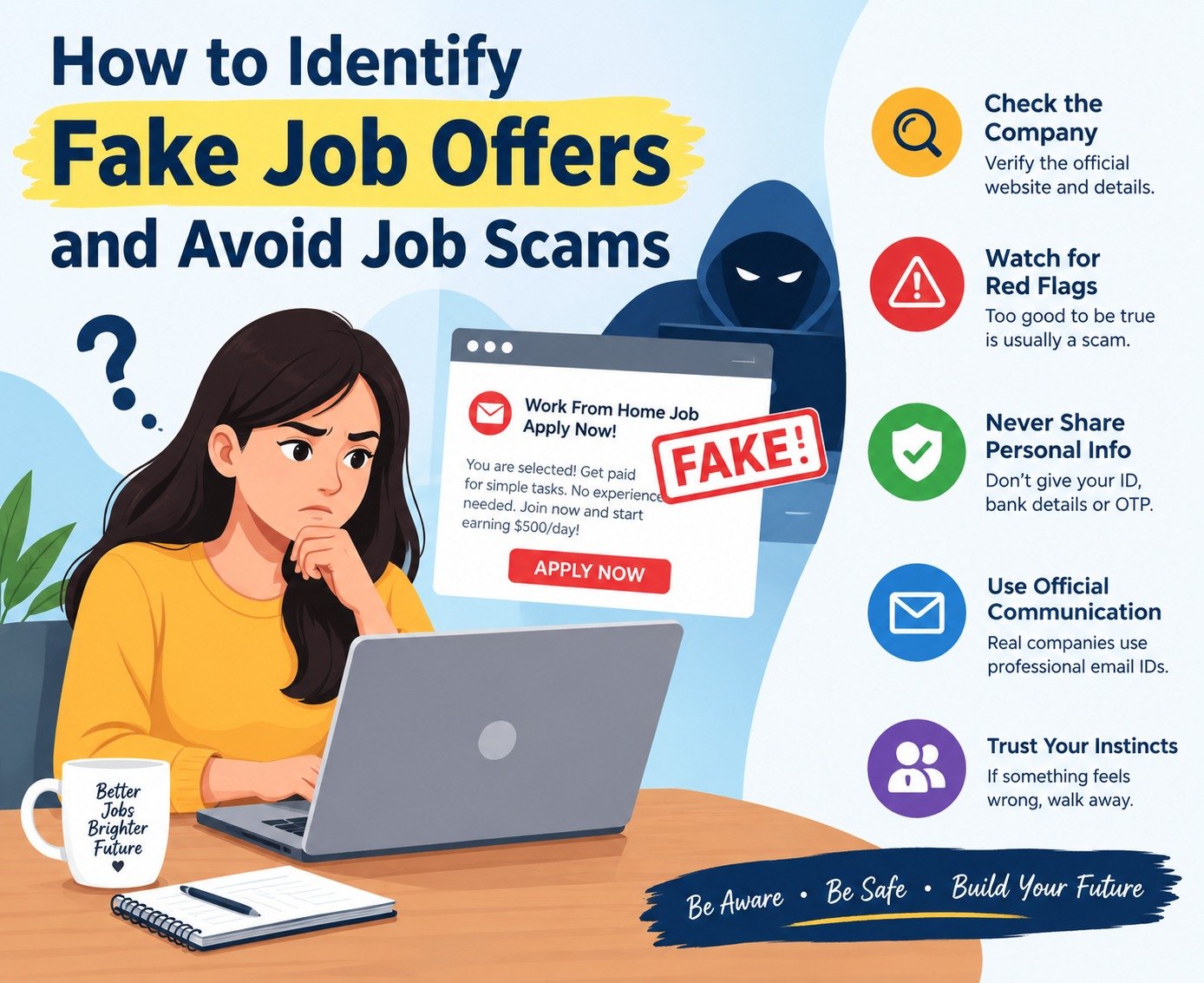
How to Identify Fake Job Offers and Avoid Job Scams
Searching for a job can be an exciting
but challenging experience. Candidates spend time preparing resumes, attending
interviews, and communicating with recruiters in the hope of finding suitable
employment. Unfortunately, scammers sometimes take advantage of job seekers by
advertising misleading vacancies or pretending to represent legitimate
companies. A careful review of Fake Job Offers can prevent avoidable problems
later.
Recognizing Fake Job Offers is an
important skill for anyone looking for employment. Some scams promise unusually
high salaries, guaranteed placements, or immediate joining in exchange for
registration fees. Others attempt to collect personal information, banking
details, or identity documents.
Understanding common warning signs can
help candidates make safer decisions throughout their job search. In this
guide, we explain how to recognize suspicious vacancies, verify employers,
protect personal information, and approach recruitment opportunities more
confidently.
1. Be Careful With Unrealistic Salary Promises
A high salary can make a vacancy
attractive, particularly to fresh graduates and candidates who have been
unemployed for some time. However, unusually generous compensation for a role
requiring little experience should encourage you to investigate further.
Fake Job Offers may promise
exceptional earnings without explaining the responsibilities, required
qualifications, working hours, or employment conditions.
Before applying, compare the
advertised salary with similar roles in the same industry and location. Ask for
a clear job description and understand how compensation is structured. A high
salary alone does not prove that a vacancy is fraudulent, but unsupported
promises deserve caution. Take these checks seriously when assessing Fake Job
Offers.
2. Never Ignore Upfront Payment Requests
Legitimate recruitment arrangements
should clearly explain any applicable charges and comply with relevant
employment laws. Candidates should be particularly cautious when someone
demands money for a guaranteed job, interview confirmation, or compulsory placement.
Some Fake Job Offers request payment
for registration, training materials, document verification, or an appointment
letter without providing credible evidence of the employer's identity.
Do not transfer money simply because a
recruiter claims the opportunity will disappear within minutes. Verify the
company independently and obtain written information about any legitimate fees
before making a payment. Independent research is especially important when
screening Fake Job Offers.
3. Verify the Company Before Applying
Before sharing your resume or personal
information, investigate the company advertising the vacancy.
Search for its official website,
business information, contact details, and genuine career page. Check whether
the advertised role appears on an official recruitment channel and whether the
recruiter can be independently verified.
Fake Job Offers may use names, logos,
and descriptions copied from real organizations to appear authentic. Contact
the company through contact information obtained independently rather than
relying only on the telephone number or email address supplied by the
recruiter.
4. Examine the Recruiter's Email Address
Professional recruiters often
communicate through company email addresses. However, email addresses alone
cannot establish whether a vacancy is genuine. These details can help
distinguish legitimate vacancies from Fake Job Offers.
Watch for misspellings, unusual
domains, unrelated email accounts, and messages that do not match the
organization's official identity.
When reviewing potential Fake Job
Offers, compare the sender's email domain with the company's verified website.
Be cautious if the recruiter refuses to communicate through an independently
verifiable channel.
Remember that scammers can also
compromise genuine accounts, so examine the complete context rather than
relying on one indicator. Never rely on promises alone when considering Fake
Job Offers.
5. Be Suspicious of Guaranteed Job Placements
No recruiter can responsibly guarantee
that every applicant will receive a job regardless of qualifications, interview
performance, or employer requirements.
Some Fake Job Offers use phrases such
as “100% guaranteed placement,” “no interview required,” or “instant
appointment” to attract candidates.
Ask how the recruitment process works,
what selection stages are required, and which organization will employ you. A
genuine employer should be able to explain the position and recruitment
procedure clearly.
Avoid paying someone who claims to
have special access to an employer but refuses to provide verifiable details. A
few minutes of verification can help you avoid Fake Job Offers.
6. Check the Job Description Carefully
A genuine vacancy should usually
provide meaningful information about responsibilities, qualifications, working
arrangements, and the employer's expectations.
Vague descriptions may indicate that
the advertiser has not provided sufficient information for candidates to assess
the role.
Fake Job Offers may list numerous
unrelated responsibilities, promise exceptional benefits, or omit the
employer's identity entirely.
Before applying, ask for clarification
about the job title, reporting structure, work location, employment type, and
expected skills. If the recruiter cannot answer basic questions, investigate
the opportunity further. Keep a record of suspicious messages related to Fake
Job Offers.
7. Watch Out for Pressure Tactics
Scammers may attempt to rush
candidates into making decisions by claiming that a position will close
immediately or that a payment must be completed within minutes.
These tactics can prevent applicants
from checking important information.
When evaluating Fake Job Offers, take
time to verify the company, read documents, and understand the terms. A genuine
hiring process may have deadlines, but a recruiter should not need to prevent
you from conducting reasonable checks.
Do not allow urgency or fear of
missing an opportunity to replace careful judgment. Discuss unclear claims
before proceeding with possible Fake Job Offers.
8. Protect Your Personal and Financial Information
Recruiters may legitimately request
certain information during recruitment, but the timing and purpose of each
request matter.
Be cautious if someone asks for
banking passwords, one-time passwords, payment card security codes, or
unnecessary identity documents before you have verified the employer.
Fake Job Offers may use requests for
sensitive information to commit identity theft or financial fraud.
Share only information that is
necessary for the relevant stage of recruitment. Use secure channels when
submitting required documents and avoid sending confidential information to
unverified contacts. Careful comparison helps reveal inconsistencies in Fake
Job Offers.
9. Research the Interview Process
A legitimate recruitment process
should provide a reasonable explanation of how candidates will be evaluated.
Depending on the position, this may include interviews, assessments, technical
tasks, or document checks.
Be cautious if a supposed employer
offers a position without asking relevant questions or evaluating your
suitability. These precautions are useful whenever you encounter Fake Job
Offers.
Some Fake Job Offers use informal
messaging alone and then request payment or personal documents.
Verify the interviewer's identity,
confirm the role through official channels, and ask questions about the
position. Video or telephone interviews can be legitimate, but their format
alone does not prove that the opportunity is genuine.
10. Read Offer Letters Before Accepting
An employment offer should clearly
communicate important terms, such as the position, compensation, joining date,
work location, and employment conditions.
Fake Job Offers may include poorly
explained terms, inconsistent company names, suspicious payment instructions,
or unrealistic guarantees.
Check the sender's identity and verify
the offer directly with the employer if anything appears unusual. Read the
complete document before signing, and request clarification about
responsibilities, probation, working hours, benefits, and termination conditions.
Ask for evidence before trusting claims made in Fake Job Offers.
Do not assume that a document is
genuine simply because it contains a logo, signature, or company stamp.
11. Be Careful With Work-From-Home Opportunities
Remote jobs can offer flexibility and
access to employers in different locations. However, scammers sometimes use the
popularity of remote work to advertise misleading opportunities. Verify every
important detail connected with suspected Fake Job Offers.
Be especially careful when an offer
promises high earnings for simple tasks but requires an initial deposit,
cryptocurrency transfer, or payment to unlock additional work.
Fake Job Offers involving task-based
schemes may display apparent earnings to encourage victims to deposit more
money.
Research the company, understand the
work involved, and never send money merely to receive wages or release supposed
earnings.
12. Verify Recruitment Agencies
Recruitment agencies can help
candidates discover suitable vacancies, but applicants should understand who is
providing the service and how the recruitment arrangement works. A cautious
approach reduces the risks associated with Fake Job Offers.
Before working with an agency, check
its identity, professional history, contact details, and relationship with the
employer.
Some Fake Job Offers are promoted by
people falsely claiming to represent established recruitment firms.
Contact the agency through an
independently verified channel and confirm whether the advertised vacancy
exists. Ask for written details about the recruitment process and any
applicable charges.
13. Use Trusted Job Platforms Carefully
Online job portals can make it easier
to discover vacancies and compare opportunities. Nevertheless, candidates
should remember that no platform can eliminate every fraudulent listing. Do not
let attractive benefits distract you from checking Fake Job Offers.
When encountering Fake Job Offers on a
job website or social media page, examine the employer details and verify the
vacancy before proceeding.
Read platform guidance about reporting
suspicious advertisements. Avoid moving immediately to unfamiliar messaging
channels when a recruiter refuses to provide basic information.
Job seekers can explore platforms such
as Jobhunterr while independently checking the employers and opportunities they
wish to pursue. Reviewing the full context is essential when judging Fake Job
Offers.
14. Know What to Do if You Suspect a Scam
If an opportunity appears suspicious,
stop sharing information and avoid making payments until you have verified the
situation.
Save relevant emails, messages,
payment requests, website addresses, and other evidence. Report the listing to
the job platform and, where appropriate, inform the genuine company whose
identity may have been misused.
If you have lost money or disclosed
sensitive information, contact your bank or payment provider promptly and
follow the relevant reporting procedures. In India, cybercrime complaints can
be submitted through the official National Cyber Crime Reporting Portal at cybercrime.gov.in. The national cybercrime
helpline is 1930 for reporting financial cyber fraud. Keep your personal safety
in mind while evaluating Fake Job Offers.
Taking prompt action may help limit
further harm.
15. Develop Safe Job-Search Habits
Safe job searching involves more than
recognizing one suspicious message. It requires consistent habits throughout
the recruitment process.
Keep your resume accurate, research
employers before interviews, use strong passwords, and maintain records of
applications. Avoid sharing unnecessary information publicly and review the
privacy settings on professional accounts. Report suspicious listings if you
believe they involve Fake Job Offers.
When you encounter Fake Job Offers,
compare the claims with independently verified information instead of relying
solely on testimonials or promises.
Ask questions, take time to evaluate
the role, and remember that declining an unclear opportunity is better than
taking an unnecessary risk.
Conclusion
Finding employment requires patience,
preparation, and careful decision-making. By checking employers, reviewing job
descriptions, protecting personal information, and avoiding suspicious payment
requests, candidates can reduce their exposure to recruitment scams.
Fake Job Offers can appear convincing,
so no single warning sign should be treated as definitive proof. Instead,
examine the full situation, verify important claims independently, and seek
clarification whenever something does not make sense.
Job seekers can use platforms such as
Jobhunterr to explore employment opportunities while taking responsibility for
verifying employers and recruitment details before accepting an offer.
Consistent verification habits can help you steer clear of Fake Job Offers.