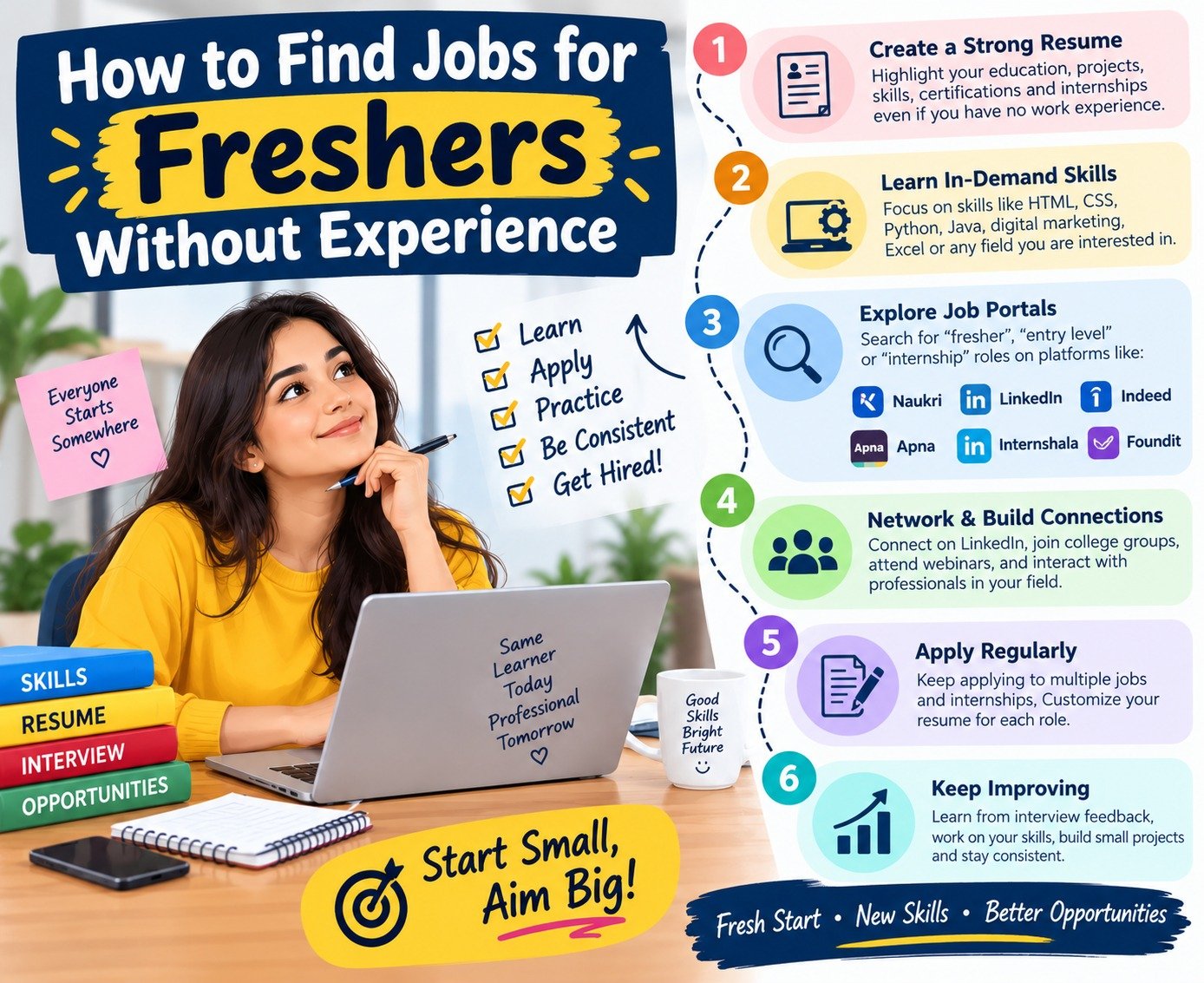
How to Find Jobs for Freshers Without Experience
Starting a career can feel challenging
when you have completed your education but have little or no professional
experience. Many employers look for candidates who demonstrate practical
skills, communication abilities, and a willingness to learn. However, fresh
graduates can develop these qualities through projects, internships, training,
and consistent preparation. A focused plan can make searching for Jobs for
Freshers more manageable.
Finding Jobs for Freshers becomes
easier when you understand how to present your strengths and identify
opportunities that match your qualifications. You do not necessarily need years
of experience to begin building a professional career.
In this guide, we explain how to
prepare a resume, improve your skills, search for suitable vacancies, prepare
for interviews, and develop a practical job-search strategy.
1. Identify Your Skills and Career Interests
Before applying for positions, think
about the subjects, activities, and tasks that interest you most. Your first
role does not need to define your entire career, but it should provide
opportunities to learn and develop.
Candidates searching for Jobs for
Freshers should list their technical skills, communication abilities, academic
strengths, and interests.
For example, a graduate interested in
digital marketing might explore SEO, content writing, social media, or online
advertising. Someone interested in technology might investigate software
testing, technical support, or junior development roles. These steps can
improve your approach to Jobs for Freshers.
Understanding your strengths helps you
focus your applications on relevant opportunities.
2. Prepare a Clear and Professional Resume
Your resume is often the first
document an employer reviews. It should communicate your qualifications,
relevant skills, education, and achievements clearly.
When applying for Jobs for Freshers,
include your contact information, educational background, technical skills,
internships, certifications, and relevant projects.
Use concise bullet points to explain
what you did and what you learned. Avoid adding inaccurate experience or
unsupported claims. Research carefully before applying to advertised Jobs for
Freshers.
Freshers can also include academic
projects, volunteering, workshops, and extracurricular activities when these
demonstrate skills relevant to the position.
3. Build Practical Skills Before Applying
Academic knowledge provides a
foundation, but many employers also value practical ability. Developing
job-related skills can help candidates demonstrate that they are ready to learn
and contribute. A strong profile can help you stand out for Jobs for Freshers.
For Jobs for Freshers in digital
marketing, useful skills might include keyword research, basic SEO audits,
content creation, and analytics. For administrative roles, spreadsheet
knowledge, written communication, and organization may be useful.
Choose skills based on the
requirements of your target role. Use reputable learning resources, practise
regularly, and create examples of your work that you can discuss during
interviews.
4. Create Projects to Demonstrate Your Abilities
Projects help candidates show what
they can do, even without previous employment.
When pursuing Jobs for Freshers,
consider creating a portfolio containing relevant examples. A marketing
candidate might prepare a sample content calendar, conduct a basic website
audit, or develop a keyword research report using publicly available information.
A programming candidate might build a
small application, while a design candidate could create sample layouts or
branding materials. Set realistic goals as you explore Jobs for Freshers.
Explain the objective, tools used,
your contribution, and the outcome of each project. Be honest about whether the
work was personal, academic, or completed for a client.
5. Search for Entry-Level Opportunities
Not every vacancy is suitable for a
beginner. Look for job titles that clearly indicate entry-level
responsibilities and reasonable experience requirements.
Candidates looking for Jobs for
Freshers can search for trainee, graduate, junior, assistant, internship, and
entry-level positions.
Read the complete job description
before applying. Compare the required qualifications with your skills and
identify any essential criteria you do not meet. Regular practice can prepare
you for interviews for Jobs for Freshers.
Do not reject yourself automatically
because you lack one preferred skill. However, make sure you understand the
core requirements and avoid misrepresenting your qualifications.
6. Use Online Job Portals Effectively
Online job platforms help candidates
discover vacancies across industries and locations. They can also make it
easier to organize applications and compare role requirements.
When searching for Jobs for Freshers,
use relevant filters for location, experience level, job category, and
employment type.
Maintain an updated profile and
provide accurate information about your qualifications. Save suitable vacancies
and record application dates so that you can follow up appropriately. Compare
role requirements when choosing Jobs for Freshers.
Jobhunterr is one platform you can
explore for available job listings. Verify each employer, job description, and
application process before sharing sensitive information.
7. Improve Your Communication Skills
Communication is important in many
entry-level positions. Employers may assess how clearly candidates explain
ideas, respond to questions, and interact with colleagues. Use feedback to
improve future applications for Jobs for Freshers.
Freshers applying for Jobs for
Freshers should practise speaking about their education, projects, interests,
and career goals.
You can improve by reading regularly,
participating in discussions, practising mock interviews, and writing
professional emails.
Fluency develops over time, so focus
on clarity, listening, confidence, and accurate communication rather than
trying to use complicated vocabulary.
8. Gain Experience Through Internships
Internships can provide exposure to
workplace expectations, practical tasks, and professional collaboration. Keep
your documents ready when applying for Jobs for Freshers.
For candidates pursuing Jobs for
Freshers, an internship may help connect classroom knowledge with real work. It
can also provide examples of responsibilities and achievements to discuss
during interviews.
Look for internships with clear
learning objectives, defined responsibilities, and transparent terms. Check
whether the opportunity aligns with your career goals.
An internship is not the only way to
gain experience. Projects, volunteering, apprenticeships, and relevant training
can also help demonstrate your capabilities.
9. Customize Your Applications
Sending the same resume to every
employer may prevent you from showing why you are suitable for a particular
position. Relevant projects can strengthen applications for Jobs for Freshers.
When applying for Jobs for Freshers,
read each description carefully and highlight the skills that match its
requirements.
Adjust your resume summary, project
descriptions, and cover letter where appropriate. Use relevant terminology
naturally, but do not copy the entire job advertisement or claim skills you do
not possess.
A focused application can make it
easier for recruiters to understand how your background relates to the role.
10. Prepare for Job Interviews
Interview preparation helps candidates
explain their qualifications and respond confidently to questions. Networking
may help you learn about suitable Jobs for Freshers.
People applying for Jobs for Freshers
should practise common questions such as “Tell me about yourself,” “Why do you
want this role?” and “What are your strengths?”
Prepare examples from academic
projects, internships, volunteering, or other relevant activities. Explain the
situation, your actions, and what you learned.
Research the company and review the
job description before the interview. Prepare a few thoughtful questions about
the responsibilities, team, and training opportunities. Check employer details
before responding to Jobs for Freshers listings.
11. Build a Professional Online Profile
Employers may review professional
profiles when evaluating candidates. A clear profile can help recruiters
understand your background and interests.
Candidates searching for Jobs for
Freshers can use professional networking platforms to describe their education,
skills, projects, certifications, and career goals.
Keep your information accurate and
consistent with your resume. Share relevant work samples where appropriate and
engage professionally with industry discussions.
Networking can help you discover
opportunities, but avoid sending repetitive messages or expecting every
connection to result in a job. Track deadlines associated with Jobs for
Freshers applications.
12. Network With People in Your Industry
Networking involves building
professional relationships and learning from people who work in your chosen
field.
For Jobs for Freshers, useful contacts
may include former classmates, lecturers, alumni, internship supervisors, and
professionals you meet at industry events.
Ask thoughtful questions about
required skills, entry-level responsibilities, and career development. Let
people know what kind of work interests you without pressuring them to provide
a referral.
Professional relationships develop
gradually. Focus on learning and maintaining genuine connections rather than
treating every interaction as a direct job opportunity. Tailor your
introduction to the specific Jobs for Freshers role.
13. Track Your Applications
A structured job search helps you
avoid confusion and identify which approaches are working.
Create a spreadsheet to record the
company, position, application date, job link, status, and follow-up date.
Candidates searching for Jobs for
Freshers can use this record to prioritize upcoming interviews and avoid
submitting duplicate applications unnecessarily.
Review your progress weekly. If you
are not receiving responses, consider improving your resume, refining your
target roles, or developing skills that appear frequently in relevant job
descriptions. Continue learning while you search for Jobs for Freshers.
14. Learn to Recognize Recruitment Scams
Job seekers should remain cautious
when evaluating unfamiliar employers and recruitment advertisements.
Be suspicious of guaranteed
placements, pressure to make immediate payments, vague job descriptions, and
requests for sensitive banking information. Your first applications can teach
you how to approach Jobs for Freshers.
While searching for Jobs for Freshers,
verify employers through independently obtained contact details and read offer
letters carefully.
Never share one-time passwords or
banking credentials with a recruiter. If an opportunity requires an unexplained
payment before employment, investigate it thoroughly before proceeding.
15. Stay Consistent and Keep Learning
Finding a first job may take time.
Some candidates receive responses quickly, while others need to improve their
applications or explore different opportunities.
The search for Jobs for Freshers
should combine consistent applications with continuous learning. Set achievable
weekly goals for applying, practising interviews, building projects, and
improving your skills.
Ask for constructive feedback when
available, review your progress, and adjust your approach when necessary. Stay
patient while looking for appropriate Jobs for Freshers.
Remember that rejection does not
automatically mean you lack ability. Employers may have different requirements,
and each application can help you understand the job market better.
Conclusion
Finding your first job without
professional experience is possible when you approach the process with
preparation and consistency. A clear resume, relevant skills, practical
projects, interview preparation, and a focused application strategy can help
you demonstrate your potential.
Jobs for Freshers are available across
many industries, but the right opportunity depends on your qualifications,
interests, location, and career goals. Research employers carefully and apply
for roles that match your current abilities while offering opportunities to
learn.
Explore job listings through platforms
such as Jobhunterr, verify each opportunity, and continue improving your
professional skills. Building a career is a gradual process, and taking
consistent steps can help you move closer to your first role. Verify each
employer before sharing details.