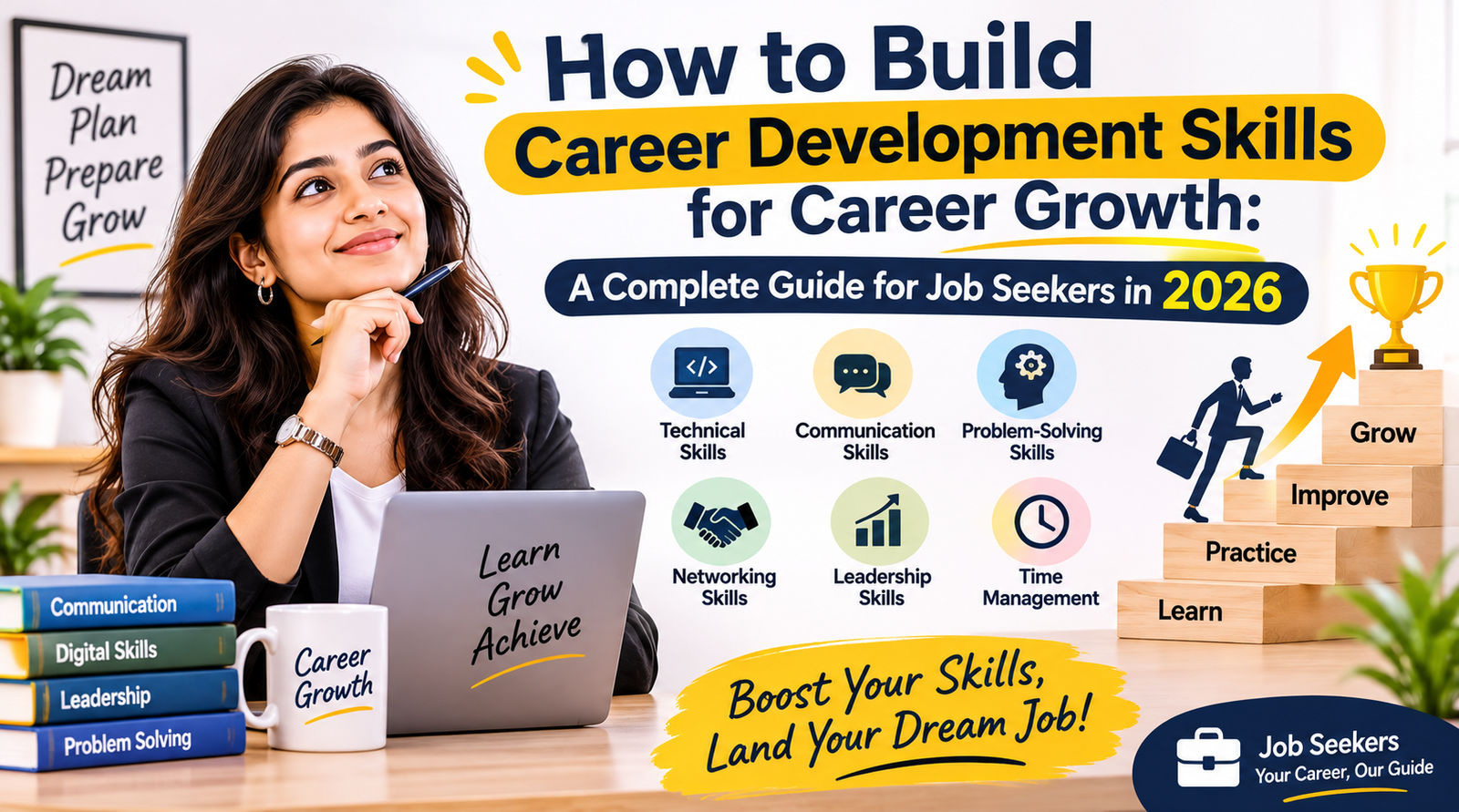
How to Build Career Development Skills for Career Growth: A Complete Guide for Job Seekers in 2026
The professional world is changing
faster than ever. New technologies, changing business requirements, and
evolving workplace expectations are influencing how companies recruit and
manage employees. Having a degree or basic qualifications may help candidates
enter the job market, but developing the right abilities is equally important
for building a successful career.
Today, employers look beyond academic
qualifications when evaluating candidates. They also consider communication,
problem-solving, technical knowledge, teamwork, and adaptability. Job seekers
who continuously improve their abilities can become better prepared for
changing employment opportunities.
Developing career development skills
is important not only for freshers but also for experienced professionals who
want to advance in their careers. Whether you are searching for your first job,
planning a promotion, or considering a career change, investing in professional
learning can improve your long-term opportunities.
In this guide, we will explore
important professional abilities, ways to develop them, and practical
strategies that can help you become more competitive in the modern job market.
1. Why Skill Development Is Important for Career Growth
Professional growth requires
continuous learning. The knowledge and abilities that are valuable today may
need to be updated as industries introduce new technologies and working
methods.
Building career development skills
helps individuals prepare for workplace challenges and changing employer
expectations. It also allows job seekers to demonstrate that they are willing
to learn and take responsibility for their professional growth.
Some important benefits include:
●
Improved employability:
Candidates with relevant abilities may be better positioned to qualify for
suitable job opportunities.
●
Better workplace performance:
Strong professional abilities help employees complete responsibilities more
effectively.
●
Increased confidence: Learning
new skills can improve confidence when handling workplace tasks.
●
Career advancement: Employees
who demonstrate valuable abilities may become suitable candidates for
additional responsibilities and leadership positions.
●
Professional adaptability:
Continuous learning helps individuals adjust to changes in their industries.
Skill development should be treated as
an ongoing investment rather than a one-time activity.
2. Communication Skills: A Foundation for Professional
Success
Communication is one of the most
important abilities in almost every profession. Employees regularly interact
with managers, customers, colleagues, and business partners. Clear
communication helps prevent misunderstandings and improves collaboration.
Important communication abilities
include:
●
Speaking confidently.
●
Writing professional emails.
●
Presenting ideas clearly.
●
Listening actively.
●
Participating in meetings.
●
Providing constructive
feedback.
How to Improve Communication Skills
Start by practising professional
conversations in everyday situations. Read articles, listen to informative
podcasts, and participate in group discussions.
You can also practise writing business
emails and presenting short topics in front of friends or colleagues. Asking
for feedback can help you identify areas that need improvement.
For job seekers, communication is
particularly important during interviews. Candidates who explain their
experience clearly and answer questions confidently can create a positive
impression.
Communication is one of the most
practical career development skills because it supports teamwork, leadership,
customer service, and professional relationships.
3. Digital Literacy and Technical Knowledge
Technology has become an important
part of modern business operations. Even professionals working outside the IT
industry frequently use digital tools to complete everyday tasks.
Digital literacy includes
understanding how to use computers, software applications, online collaboration
tools, and digital platforms.
Depending on your career interests,
useful abilities may include:
●
Microsoft Excel.
●
Microsoft Word.
●
PowerPoint presentations.
●
Google Workspace.
●
Project management software.
●
Customer relationship
management tools.
●
Basic data analysis.
●
Cybersecurity awareness.
Technical requirements differ between
industries. Therefore, candidates should identify the digital tools commonly
used in their preferred profession.
For example, an administrative
assistant may benefit from spreadsheet and document-management knowledge, while
a marketing professional may need experience with analytics and digital
marketing platforms.
Learning relevant technology is an
important part of developing career development skills. Start with the tools
mentioned in job descriptions for positions you want to apply for.
4. Problem-Solving and Critical Thinking
Employers value individuals who can
understand challenges and identify practical solutions. Problem-solving
involves analysing information, evaluating alternatives, and making informed
decisions.
For example, a customer support
executive may need to resolve a customer complaint, while a software developer
may need to identify an issue in an application. Both situations require
logical thinking.
Ways to Develop Problem-Solving Abilities
- Practise analysing real-world situations.
- Break
complicated tasks into smaller steps.
- Compare
different possible solutions.
- Learn
from previous mistakes.
- Ask
relevant questions before making decisions.
- Evaluate the results of your actions.
Critical thinking also helps
professionals avoid making decisions based on assumptions or incomplete
information.
You can improve these abilities by
participating in group projects, solving practical exercises, and discussing
different approaches with experienced professionals.
Problem-solving is among the career
development skills that can help employees contribute more effectively to
business goals.
5. Time Management and Productivity
Managing time effectively is important
for employees working in different industries. Professionals often handle
multiple assignments, meetings, and deadlines. Without proper organisation,
tasks may become difficult to manage.
Useful time-management practices
include:
Prioritise responsibilities: Identify
urgent and important tasks before starting your day.
Create daily schedules: Use calendars
or task-management applications to organise activities.
Avoid unnecessary distractions: Reduce
interruptions when working on important assignments.
Set realistic deadlines: Allocate
sufficient time to complete tasks properly.
Review progress: Evaluate completed
work and identify areas that require improvement.
Good time management supports
productivity and helps employees maintain a better balance between professional
responsibilities and personal activities.
For job seekers, demonstrating
organisation and time management can strengthen interview answers and practical
examples on a resume.
6. Leadership and Teamwork Skills
Leadership is not limited to managers
or senior executives. Employees at different career levels can demonstrate
leadership by taking responsibility, supporting colleagues, and contributing to
team objectives.
Teamwork involves collaborating with
people who may have different backgrounds, experiences, and opinions.
Important leadership and teamwork
abilities include:
●
Responsibility.
●
Decision-making.
●
Conflict resolution.
●
Delegation.
●
Empathy.
●
Collaboration.
●
Accountability.
Candidates can develop these abilities
through group projects, volunteering, internships, and workplace
responsibilities.
For example, leading a college project
can demonstrate planning, coordination, and decision-making. Supporting a
colleague during a challenging assignment can demonstrate teamwork.
These experiences help candidates
provide evidence of their career development skills even when they have limited
professional experience.
7. Adaptability and Continuous Learning
Modern workplaces frequently introduce
new systems, processes, and technologies. Employees who can adjust to these
changes may find it easier to remain productive.
Adaptability includes being willing to
learn new methods, accepting constructive feedback, and responding positively
to unexpected challenges.
Continuous learning can involve:
●
Online certification courses.
●
Industry workshops.
●
Professional webinars.
●
Practical assignments.
●
Mentorship programmes.
●
Industry-related reading.
The objective should be to develop
relevant knowledge that supports your career direction.
You do not need to learn every new
technology or follow every industry trend. Instead, identify changes that are
likely to affect your preferred profession.
A willingness to learn is one of the
career development skills that can help professionals remain prepared for
changing responsibilities.
8. Data Analysis and Analytical Thinking
Data is increasingly important in
business decision-making. Companies use information to understand customers,
monitor performance, and identify business opportunities.
Even basic analytical abilities can be
useful in many professions. Employees may need to interpret sales reports,
review customer feedback, or compare performance results.
Beginners can start by learning
spreadsheet functions, basic statistics, and data visualisation. As their
experience increases, they can explore specialised tools relevant to their
industry.
Analytical thinking also involves
identifying patterns, asking questions, and understanding what information
means before making decisions.
9. Emotional Intelligence in the Workplace
Emotional intelligence refers to the
ability to recognise and manage emotions while understanding the feelings of
others. It supports healthy workplace relationships and effective
communication.
Important elements include:
●
Self-awareness.
●
Self-regulation.
●
Empathy.
●
Motivation.
●
Relationship management.
Employees with strong emotional
awareness may find it easier to handle feedback, manage workplace
disagreements, and collaborate with colleagues.
You can improve emotional intelligence
by listening carefully, considering different perspectives, responding calmly
to criticism, and reflecting on your own behaviour.
These abilities can support
professional relationships and help employees become more effective team
members.
10. How Freshers Can Develop Professional Skills Without
Experience
Freshers sometimes believe that they
need a job before they can develop workplace abilities. However, there are
several ways to gain practical experience before entering full-time employment.
Participate in Internships
Internships provide opportunities to
understand workplace responsibilities and industry expectations. They also
allow students and fresh graduates to apply their academic knowledge in
practical situations.
Work on Personal Projects
Create projects related to your
preferred profession. For example, aspiring graphic designers can build
portfolios, while aspiring developers can create sample applications.
Attend Workshops
Professional workshops provide
exposure to practical concepts and industry practices. They can also offer
opportunities to interact with people working in your chosen field.
Volunteer
Volunteering can help develop
teamwork, communication, and organisational abilities. It also provides
examples that can be discussed during job interviews.
Complete Online Courses
Online learning platforms provide
opportunities to study different subjects and practise new techniques.
These activities allow freshers to
build career development skills before they receive their first full-time job
offer.
11. How to Showcase Your Skills on Your Resume
Developing skills is important, but
employers also need to understand how those abilities relate to the job. Your
resume should highlight relevant capabilities instead of listing every skill
you have encountered.
Consider these practices:
●
Read the job description
carefully.
●
Identify the most relevant
requirements.
●
Include technical skills that
match the position.
●
Mention certifications where
relevant.
●
Describe practical projects.
●
Highlight measurable
achievements.
●
Avoid exaggerating your
abilities.
For example, instead of simply writing
"Good communication skills," you could explain how you presented
project updates or coordinated activities during a college project.
Specific examples make your abilities
easier to evaluate.
Your resume should also be updated
whenever you complete a relevant course, gain practical experience, or develop
new professional capabilities.
12. Creating a Personal Career Development Plan
A career development plan provides
direction and helps you track professional progress. It makes learning more
organised and helps you focus on abilities that support your long-term goals.
You can create one by following these
steps.
Step 1: Identify your career goals.
Decide what type of role or
professional position you want to achieve.
Step 2: Evaluate your current
abilities.
Identify the skills you already
possess and the areas where you need improvement.
Step 3: Research industry
requirements.
Review job descriptions to understand
what employers expect from candidates.
Step 4: Select learning resources.
Choose suitable courses,
certifications, workshops, and practical projects.
Step 5: Set realistic timelines.
Divide your learning objectives into
weekly and monthly targets.
Step 6: Track your progress.
Review your achievements and update
your learning plan whenever necessary.
A structured approach makes
professional learning more manageable. It also helps you measure improvements
instead of relying only on general goals.
13. How JobHunterr Helps You Explore Career Opportunities
Developing professional abilities is
only one part of building a successful career. Finding suitable employment
opportunities is equally important.
JobHunterr helps job seekers discover
employment opportunities across different industries and locations.
Candidates can explore job vacancies,
browse categories, search for opportunities in India and abroad, and access
career-related resources.
Employers can also use the platform to
connect with potential candidates and explore recruitment opportunities.
Whether you are a fresher entering the
workforce or an experienced professional looking for a new opportunity,
JobHunterr can help you explore available career options.
Combining continuous learning with
active job searching can help you take practical steps towards your
professional goals.
Conclusion
Professional growth requires more than
academic qualifications or previous work experience. It depends on continuous
learning, practical knowledge, and the ability to adapt to changing workplace
expectations.
Developing career development skills
such as communication, digital literacy, problem-solving, teamwork, leadership,
and time management can help individuals become better prepared for
professional responsibilities.
The best approach is to identify your
career goals, understand industry requirements, and consistently work on
improving relevant abilities.
You do not need to master every skill
immediately. Start with the abilities that matter most to your chosen
profession and gradually expand your knowledge.
Explore employment opportunities
through JobHunterr, continue improving your professional abilities, and take
the next step towards building a successful career.
Frequently Asked Questions
1. What are the most important skills
for career growth?
Communication, problem-solving,
teamwork, digital literacy, adaptability, and time management are valuable
across many professions.
2. How can freshers develop
professional skills?
Freshers can develop abilities through
internships, personal projects, online courses, workshops, and volunteering.
3. Why is continuous learning
important?
Continuous learning helps
professionals update their knowledge and adapt to changing industry
requirements.
4. How do I identify which skills I
need?
Review job descriptions in your
preferred industry and identify the abilities employers frequently request.
5. Can professional skills improve job
opportunities?
Relevant abilities can strengthen your
applications and demonstrate your ability to handle workplace responsibilities.
Additional FAQs for Blog 1
6. How can I improve my career
development skills at home?
You can improve your career
development skills at home by following online lessons, practising
communication, and completing practical projects.
7. Are career development skills
important for freshers?
Yes. Career development skills help
freshers demonstrate their readiness to learn, work with others, and handle
professional responsibilities.
8. How often should I update my career
development skills?
Review your career development skills
regularly, especially when your industry introduces new tools, technologies, or
job requirements.
9. Can online courses help build
career development skills?
Online courses can strengthen your
career development skills by providing structured lessons, practical exercises,
and opportunities to learn new subjects.
10. How do employers evaluate career
development skills?
Employers may evaluate career
development skills through interviews, practical assessments, previous
projects, and examples of workplace behaviour.
11. Which career development skills
should I learn first?
Start with career development skills
that appear frequently in job descriptions for the positions you want to
pursue.
12. Can career development skills help
with promotions?
Yes. Relevant career development skills can help employees prepare for greater respons